Next Level Basketball

NEXT LEVEL METHODOLOGY

NEXT LEVEL BASKETBALL AND METHODOLOGY

“We distinguish between two methodologies: Traditional and Dynamic. Traditional training focuses on motor learning outside of the game context. Dynamic training brings in decision making and variability. The pillars of dynamic training are the Games-Based Approach (GBA) and the Constraints-Led Approach (CLA). These two approaches are sequential, as the GBA is a foundation upon which to utilize CLA, which is our primary tool for skill acquisition. While we are a dynamic training organization, we are constantly evaluating the balance we implement between traditional approaches and dynamic ones. This approach is fully integrated throughout our program, from athletic development, to skill development, to club team practices.”
Our program has an integrated approach. For instance, the CLA is the apex method that our coaches utilize in every component of our program. Our athletic development coaches, certified personal trainers (CPT) who specialize in basketball, incorporate these methods seamlessly into our training in the weight room and on the turf. Our skill development coaches take the same approach on the court, and our club team coaches are guided primarily by the same methods in our practices. Our coaches also make decisions on how to best balance blocked practice with dynamic practice approaches as needed. Our player development program is based on a unified, integrated system.

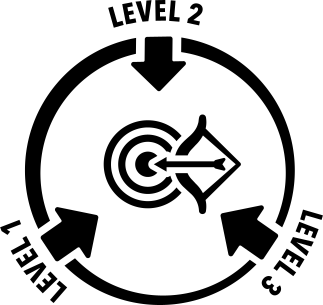
For us at Next Level Basketball, a challenge point framework guides the balance we approach our player development sessions with. The challenge point framework is how we conceptualize our choices in addressing individual player needs. Different tasks challenge players differently. This is why we separate our athletes into level one, level two and level three in our programs. Depending on the level of the player, we adjust the difficulty of the drill. We want a failure rate that demonstrates that a player is challenged, but an overwhelming failure rate isn’t helpful. We want to hover around this optimal challenge point for every player.

Challenge Point Framework

The Challenge Point Framework is a guide to optimizing learning. The goal is to find the right balance in challenging players. According to this framework, learning is more efficient when players are challenged sufficiently, but not to the point where they are overburdened. This is why we separate players into level one, level two and level three groupings, each with different curriculums to follow. Our goal in doing this is to hover around the optimal challenge point for every player.

TRADITIONAL TRAINING

The Traditional Skill Approach (TSA) is based on practicing technique outside of the game context. The priority when instructing through a traditional lens is motor skills. This is exemplified by putting players through a progression of breaking skills down into smaller tasks and correcting their movement patterns in the process. This approach doesn’t deny dynamic training, it only suggests that a foundation should come first (Manninen et al. 2024). More contemporary TSA’s question linear learning expectations and focus on goal directed corrections instead of motor skill ones, which implies that these methods could be integrated with dynamic training in specific contexts (Lindsay and Spittle 2024). In our view at Next Level Basketball, traditional methods can be useful in some contexts, but it is not our primary skill acquisition tool and its use is dependent on context.

DYNAMIC TRAINING

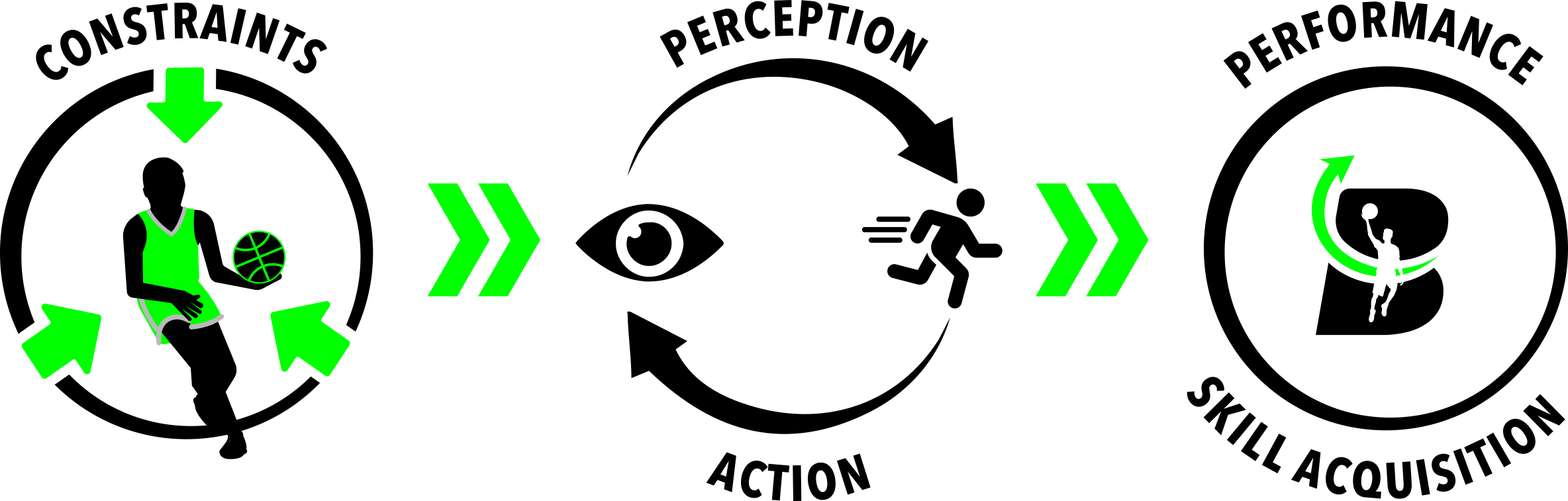
What we call Dynamic training are any methods that involve variability and decision making. These methods have “repetition without repetition” built in because they involve live defenders. The foundation of this is the Games-Based Approach (GBA). The GBA uses small-sided games – such as 3-on-3 or 1-on-1– to replicate pieces of the 5-on-5 game. The GBA creates a context-rich environment where players can develop their decision making skills. Dynamic training is enhanced by using a Constraints-Led Approach (CLA). When using the CLA, coaches manipulate the games or drills, often by changing the rules or goals, to induce new solutions. This approach suggests that movement skills emerge from individual interaction with constraints (Lindsay and Spittle 2024).

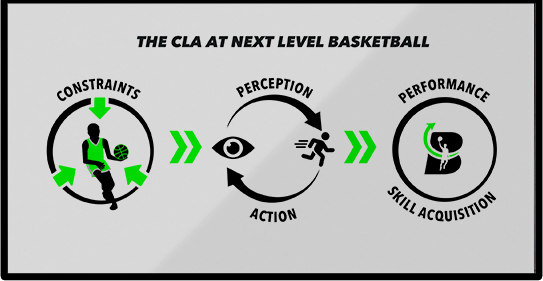
THE CLA AT NEXT LEVEL BASKETBALL

The CLA is our primary tool to enhance performance by creating a challenging, engaging environment where players are forced to solve problems on the court through constraints.

THE RESEARCH

The following are some of the peer-reviewed studies that inform our methodological approach at Next Level Basketball.

The adaptable coach – a critical review of the practical implications for traditional and constraints-led approaches in sport coaching.

The effect of game-based approaches on decision-making, knowledge, and motor skill: A systematic review and a multilevel meta-analysis

The effectiveness of constraints-led training on skill development in interceptive sports: A systematic review

Coaching the Power Clean: A Constraints-Led Approach
Scroll to Top